
Disclosure: Senior Golf Life may earn a commission from qualifying purchases through affiliate links on this site, at no additional cost to you.
If you are returning to golf after a few years away, or joining a club for the first time, the golf etiquette rules for seniors you need to know have not changed much. Most of them are courtesies rather than formal penalties under the official rules of golf, but experienced players hold them in equal regard — see the USGA’s Rules of Golf for the parts that are actual rules, such as ball-mark repair. Knowing them makes every round more enjoyable — for you, for your playing partners, and for the groups behind you. Here is what you need to know, from the first tee to the final putt.
On the tee box
Stand still and stay silent when a playing partner is addressing the ball and taking their swing. Movement or noise inside a player’s peripheral vision is distracting and considered poor form. Stand to the side of the player — never directly behind them in line with the target. Wait until each person in the group has hit before moving toward the fairway.
Follow the honors rule whenever your group agrees to use it — the player with the lowest score on the previous hole tees off first. If the group is playing ready golf to speed up pace, the first person ready tees off instead. Know which format your group is using before the round starts, and do not hesitate to ask.
Playing in the fairway
One of the most important golf etiquette rules for seniors — and for all golfers — is to play without delay. Walk to your ball, read the situation, take one or two practice swings, and play. Be ready when it is your turn. Waiting until everyone else has hit to start your routine slows the entire group down.
Stay out of a fellow player’s line of sight and avoid walking through their intended target line. This is especially important on the putting green but applies anywhere a player is lining up their next shot.
Repair any divots you take in the fairway. Courses often provide sand-and-seed mix in a bottle on the cart or in the bag. Fill the divot, press it down, and move on. It takes ten seconds and is one of the simplest ways to show respect for the course and the players behind you.
Bunker play
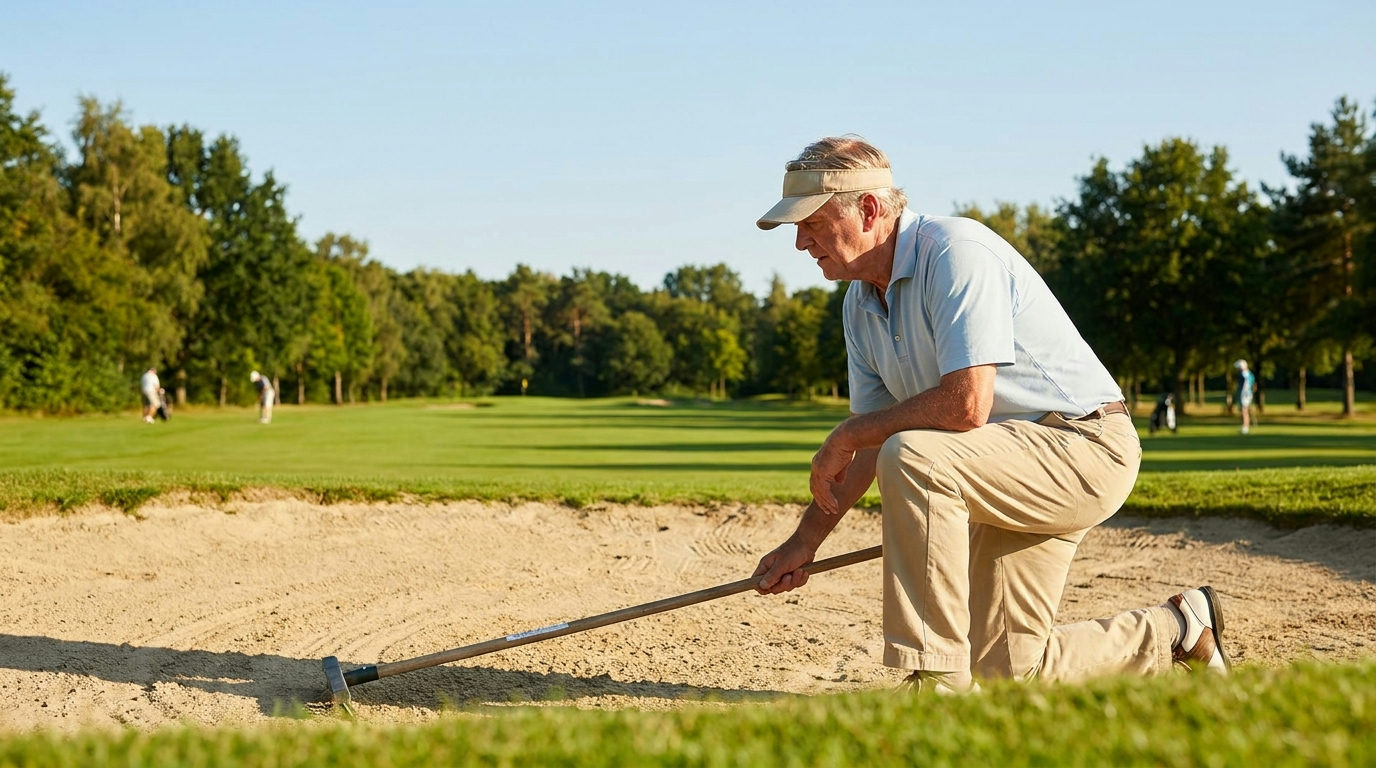
Always rake the bunker after you play from it. Enter and exit from the low side closest to your ball to limit the footprint you leave behind. Rake from the center of your footprints outward in smooth strokes, then place the rake outside the bunker or flat inside it according to the course’s local rules. It is a small effort that makes a real difference for the next player who finds the sand.
On the putting green
Never walk across another player’s putting line — the path between their ball and the hole. Footsteps compress the grass along the line and can affect how the ball rolls. Walk around. Mark your ball with a coin or small marker when it might interfere with another player’s line, and replace it in the exact same spot before you putt.
Tend the flagstick when asked. Stand to the side, hold the flag to keep it from flapping in the wind, and remove it smoothly when the ball is in motion toward the hole. Whether the flagstick stays in or comes out is the putting player’s call, so ask before you touch it; a quick word avoids any confusion.
Repair ball marks on the green. A ball landing from height leaves a small crater in the surface. Use a divot repair tool to push the edges toward the center and smooth it flat. The Rules of Golf generally let you repair ball marks and similar damage on the putting green before you putt, including marks left by previous groups — see Rule 13 for the exact wording. Get in the habit of fixing at least one mark per green, whether it is yours or not.
Pace of play
Pace of play is the etiquette issue that ripples furthest across the course, affecting every group behind yours. “Ready golf” — playing when you are ready and it is safe, rather than waiting strictly for honors — is the usual approach in casual play, and the Rules of Golf support it as a way to keep rounds moving. You should feel comfortable doing the same once your group agrees.
Walk at a steady pace, limit practice swings to one or two, and make your club selection before you reach the ball. If your group falls more than a hole behind the group ahead, wave the group behind you through. Course marshals may also ask you to pick up the pace — accept it graciously and adjust. Senior golfers who build a smooth, consistent pace into their game are always welcome playing partners.
Golf cart etiquette
Stay on the cart path near tees and greens unless local rules indicate otherwise. Driving across fairway areas near the green compacts the soil and damages the turf over time. Follow the ropes or markers the course has set up, and where a course asks carts to stay on the path until level with the ball before angling in, follow that local rule.
Keep cart noise to a minimum near players who are about to swing. Park where you do not block other groups’ view of the hole and do not force anyone to backtrack unnecessarily.
Mobile phones on the course
Keep your phone on silent or vibrate for the round. Calls during another player’s swing break concentration and are a breach of the golf etiquette rules for seniors and all golfers. If you need to take a call, step away, keep it brief, and catch up promptly. GPS and scoring apps are welcome — just keep the screen brightness low and the sounds off.
How senior golfers set the standard
Senior golfers often have the advantage of experience, and that experience is genuinely valuable to newer players. When a playing partner is unsure of an etiquette convention, a quiet, friendly word between holes is always appreciated. Avoid correcting on the tee in front of everyone — a private moment is far more effective and far more kind.
Senior golfers who use a cart for mobility should feel no hesitation about it. What matters is staying out of the way of play and keeping the round moving. The combination of forward tees and a cart makes the game genuinely accessible at any age, and that is worth celebrating. Modeling good etiquette quietly, without commentary, is the most effective teaching any experienced golfer can offer.
Conclusion: the bottom line on golf etiquette rules for seniors
Golf etiquette rules for seniors come down to two core ideas: be considerate of your playing partners, and keep the game moving. Repair what you damage, stay quiet when others are playing, and pace yourself to the group in front. These habits make every round better for everyone on the course — including you. Golfers who build these courtesies into their game are always invited back, always welcomed in new groups, and always leave the course a little better than they found it.
Check our guide to golf tee colors to make sure you are starting from the right set of tees for your game, and our scorecard guide to track your round accurately once you are out there.